The Odyssey
Release Date: July 17th, 2026
Director: Christopher Nolan | MPA Rating: R | LeavittLens Rating: 9/10
In many ways, Christopher Nolan’s entire career has been an odyssey of telling one story, again and again, like a man trying to find a home which echoes to him across time, space, and layers of his own subconscious. The result is a career that has been windingly and inevitably hurtling its way towards his adaptation of Homer’s classic The Odyssey—that foundational Western story which informs every Nolan story at some level, and which you vaguely remember from your late-night SparkNotes sessions in high school. If the Greek gods are indeed out there somewhere, shaping the fated future by their power and whim, this director-story combination is terrific evidence of their conniving.
Indeed, such an influential epic is perhaps the only direction Nolan could go following 2023’s Oppenheimer, itself adapted from a massive Pulitzer Prize-winning book—American Prometheus—which takes no qualms with deriving its title and themes from Greek mythology. Where can the world’s greatest spectacle filmmaker (affectionate) go after telling the story of the greatest threat to human existence ever created? Back to a time of “apparent magic,” where mythologies and monsters replace the atom bomb as the artifacts which tell of humanity’s brilliance and flaws.
That moniker—”In a world of apparent magic…”—opens the movie with a sort of agnosticism which belies what Nolan manages to create here: a film which not only wonders visually and verbally about the mystery and spirituality underneath and running through the world and humanity, but which ultimately brings the audience into its own movie-magic in a way equal parts awe-inspiring and involving.
The film follows Odysseus (Matt Damon), king of Ithaca, as he struggles to return home to his wife, Penelope (Anne Hathaway), and son, Telemechus (Tom Holland), following the fall of Troy. What should have been a brief voyage stretches into a years-long ordeal through a world inhabited by a cyclops, sirens, witches, sea monsters, and gods whose hands are all over the lives of the story's humans. Meanwhile, at home, suitors seeking a throne by the hand of the beautiful Penelope have all but moved into Odysseus’ home, eating and drinking to the delight of their hearts and bellies and creating an urgency for Odysseus’ return.
Damon is superb in the lead role, possessing exactly the sort of weathered shrewdness, withered longing, and physical prowess the journey requires. His Odysseus never loses the confidence and cleverness that made him great, though you can see that confidence slowly transform into humility as the miles accumulate, a thematic exploration which marks an important departure from the original text. Hathaway brings remarkable emotional gravity to Penelope, refusing to play the patient wife as a passive damsel in distress but rather a thoughtful, creative opposer to the clamoring suitors. Robert Pattinson’s turn as the most weasley of such suitors, Antinous, is a performance which chews on the scenery as much as he chews on the king’s food, and in the end becomes the perfect cartoonish antagonist for such an epic and expansive tale.
The rest of the cast manages to keep steady this admittedly difficult balancing act of sustaining the epic scale without drifting into self-parody. They are helped in this by a colloquial screenplay that mostly works: while every so often a line of dialogue lands with the awkwardness of a record scratch—see Elliot Page’s “stuff” or Tom Holland’s “dad”—these moments are rare. More often than not, the cast’s application of this accessible language allows modern audiences to inhabit the ancient story and imagery without constantly needing to translate it in their heads.
This choice also allows Nolan to embrace what he does best: creating a world so compelling that we don’t want to leave, even after its 173-minute runtime is up. Stories are emerging of people who simply refused to leave the theatre after the closing credits rolled, so swept up were they in its excitement, world-building, themes, and spectacle. If Roger Ebert had it right that a great film “continues to grow after you’ve seen it,” and Paul Schrader was right that the deepest effect of a film (its transcendence) arrives after it ends, then Nolan sure has a great one on his hands here.
Such a transcendent experience is grounded in his commitment to practicality and in-camera work, a staple of Nolan’s filmography and perhaps his greatest quality as a filmmaker. You don’t have to go far to learn about this in The Odyssey—there’s a streaming documentary you can watch in addition to the cast’s promotional interviews which incessantly emphasize the film’s remarkable practicality. It pays dividends in the final product: the islands Odysseus’ crew visits are beautifully real, the castles and costumes and Trojan horse were all actually crafted, and even the monsters of the myth used as much in-camera and practical effects as possible. Jet skis were used to create the water effects for Charybdis; a real actor in real makeup was combined with a massive mechanical puppet to create the Cyclops; terrific composing from Ludwig Göransson and sound editing from Craig Henighan came together with fog and strategic editing to bring the shrouded Sirens to life; even Circe’s transformation of Odysseus’ crew into pigs was done completely practically, creating a monstrous delight that signals Nolan’s first real foray into a form of horror filmmaking which would make David Cronenberg proud. None of this feels like a flex of hubris, either. It is instead a commitment to artful and experiential rendering which enhances the telling of the story, and in a world so over-saturated with lazy CGI, soundstages instead of real locations, and hilariously arrogant and ignorant tech moguls claiming AI can make something better, Nolan’s work creates an unrivaled tactile excellence. We not only see but feel the story as real because, through the lens of Nolan’s IMAX cameras, it is.
Nolan is helped again by the addition of Jennifer Lame to his team, who has now edited his last three films. Her cutting style—which regularly has characters saying their lines before they enter the frame, cutting quickly to characters before they finish their dialogue, and rarely dwells on images for longer than just a few seconds—meshes perfectly with Nolan’s compelling image-making and Hoyte van Hoytema photography. Such peak craftsmanship marries beauty and detail with propulsive energy, and illustrates a willingness of Nolan over the years to progressively entrust his vision and work to the sort of teammates who amplify his strengths and supplement his weaknesses.
Beyond all the markers of technical excellence, however, The Odyssey notably continues a pattern of growth for Nolan as a thematic storyteller and image-maker, a maturation which markedly began with Oppenheimer. While his earlier films had a propensity to get mired in exhausting exposition that often sacrificed character on the altar of concept and refused to trust the audience enough to experience and interpret his impressive image-making, The Odyssey largely dispenses with this over-explaining, opting instead to use the imagery and ideas at the heart of Homer’s classic as a template for a larger social and moral commentary on contemporary culture.
As some context: Homer’s original epic frames Odysseus as a hero defined by his often deceptive cunning. The first adjective Homer uses to describe him is the word polytropos, translated variously as “a man of twists and turns,” “skilled in contending,” or—simply—”complicated.” From his invention of the Trojan horse, his tricking of the Cyclops with a linguistic flourish, and his hidden return home as a means to slaughter the suitors, his metis—that is, his wily and devious nature—is the central marker of his brilliance. Add in his violent and resilient triumphs at home and abroad and his persistent womanizing, and Odysseus’ character becomes a celebrated, though still flawed, hero in Greek mythology.
While Nolan certainly retains much of his hubris and violence in the beats of the story, his adaptation functionally shifts the moral center from a pagan expression of shrewdness and power over to a more functionally—though not explicitly—Christian expression of humility, repentance, and transformation. Odysseus’ journey becomes one of surrender rather than coronation. He doesn't fight his way home so much as give himself over to the gods piece by piece (a sort of death to self that he might live); there are no explicit affairs in Nolan’s adaptation, in contrast to the many sexual exploits in the original; and the final beggar disguise is where his surrender culminates in earnest, as he assumes the lowest position rather than asserting his place on the throne via force. This is the same device Homer's Odysseus uses to infiltrate and destroy, but in Nolan—having heard Agamemnon's warning from the underworld that vengeance simply breeds more vengeance—he wears it not as a weapon but as a kind of penance, recognizing that violent triumph only perpetuates more of the same thing, and will ultimately be the end of all societies, including his own.
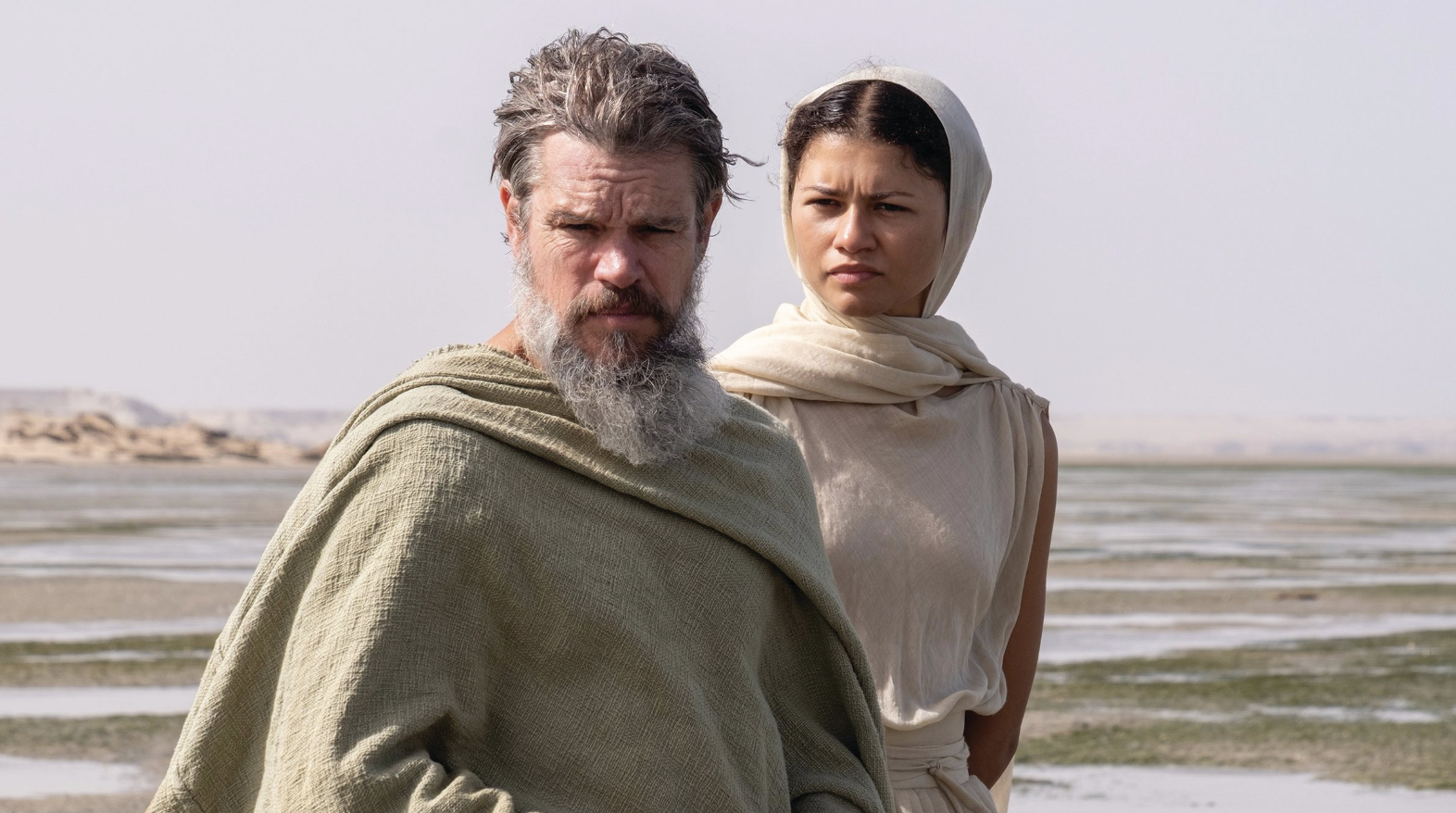
That posture carries through his first conversation with Penelope upon his return: she sits behind a shrouded screen, set up not unlike a confessional booth, and Nolan portrays Odysseus tracing his story to his wife, returning to many images we’ve already seen as an audience. Yet in this retelling, Nolan adds new visual context to accompany Odysseus’ description, and slowly he confesses that the deceptive and violent methods he and his men have used in their pillaging and conquering are fundamentally destructive, not admirable. This culminates in one of the most impressive visual motifs in Nolan’s filmography: throughout the film, we’ve watched Athena (Zendaya) challenge and guide Odysseus during his journey. Now, she shows up in Odysseus’ repentant retelling of Troy’s destruction, but not as a goddess—as the enemy’s slave girl. Connecting this to another repeated visual image of the beheading of an Athena statue in Troy, Odysseus reveals that what he once saw as a defiant victory through a show of force was actually his demeaning of the bearer of the divine image. Athena's own image stares back at him, a flicker of the divine in exactly the kind of person his old self would have counted as a trophy of war. The Sea People, that half-mythic raiding horde hinted at throughout the story, are thus revealed to be Odysseus and his men themselves, still failing to live under Zeus's law, still marauders dressed as heroes.
The epic battle scene finale contains a similar retelling: while Odysseus certainly disposes of many of the suitors in the name of justice, he does this only to those who explicitly attack him—more than half the room bows the knee to him, and he shows mercy on them, quite the contrast to Homer’s hero, whose slaughter expands even to the maidservants in the original. Then, having left his kingdom in the hands of his son, Odysseus sails West towards the sunset with Penelope, choosing to abdicate his power and honor his men. It’s in their culminating conversation we get the reveal behind Nolan’s final recurring image: as Odysseus and his wife discuss whether civilization can endure, Nolan finally cuts to another image from the sack of Troy he’s been returning to, one where Odysseus stares in a fearful wonder off-screen at we know not what. Except in this finale, we see what he’s been staring at: the Trojan Horse, that masterpiece of trickery and costume of violence, which now burns, not as a monument to what won the war, but as the admission of what has to die if anything resembling civilization is going to survive the violent propensities of men.
It is this image that closes the film, a timely and resounding condemnation of the pagan urge towards violence and power. The burning horse is Nolan’s pleading with a Western world mired in deception, corruption, and violence towards the outsider: we need to urgently put to death such propensities, picking up instead humility, self-sacrifice, xenia (welcome of the stranger in need), and peace, all of which were historically introduced by Christianity in response to its pagan context. While Nolan’s film would have been foolishness to the Greeks—and certainly to those posing as Christians who embrace such pagan notions in our own time—it is an urgent thematic sequel to his sobering Oppenheimer, a pleading to return to the sorts of values which have shaped the best of cultures in our human history.