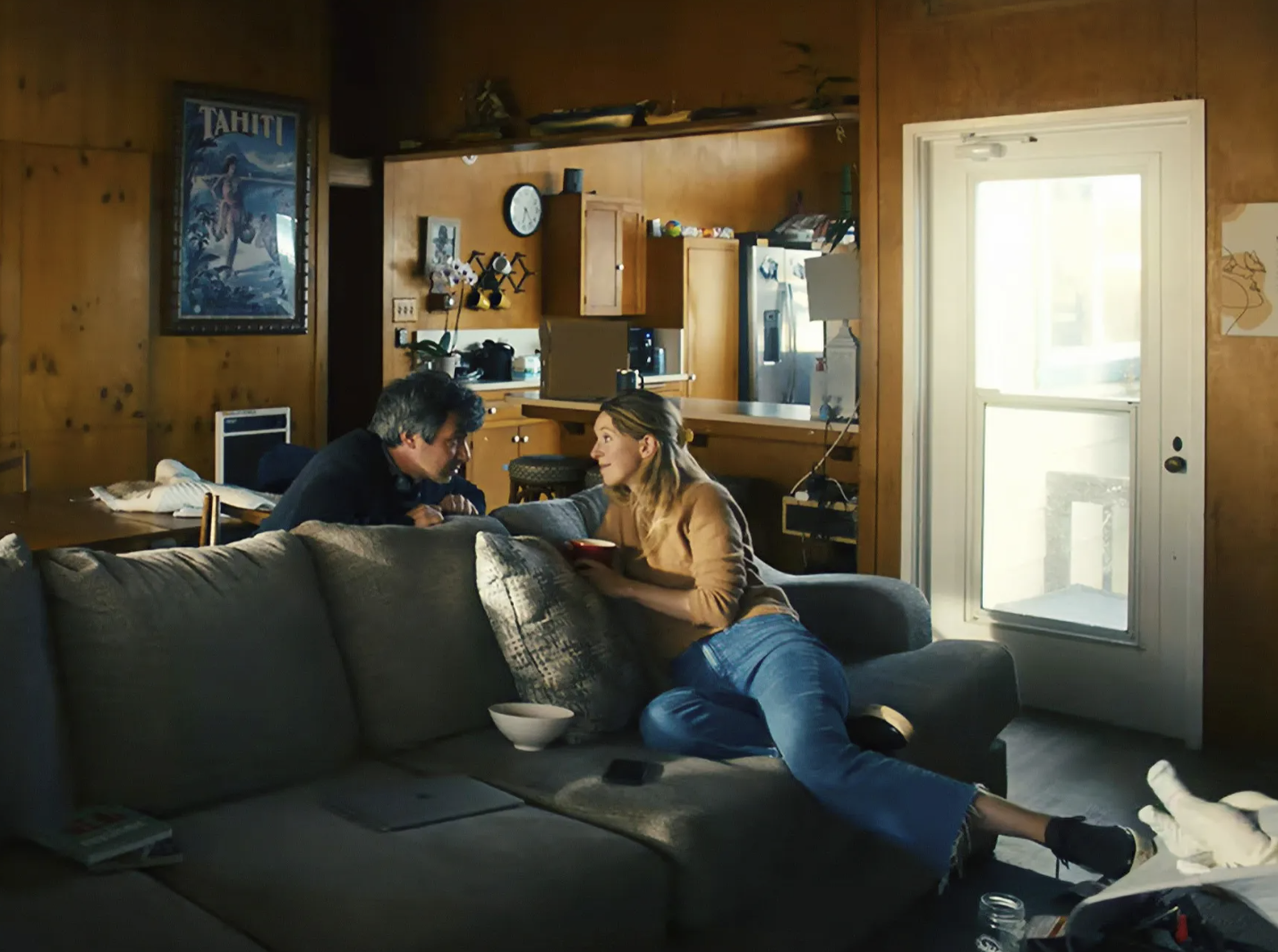
Release Date: October 16th, 2026
Directors: Lance Oppenheim, Nathan Fielder | MPA Rating: R | LeavittLens Rating: 9.5/10
“Truth and untruth often coexist; good and evil often are found together." -Mahatma Gandhi
“What is truth?” -Pontius Pilate
As a form of storytelling, documentary filmmaking is, by definition, about telling the truth. As Scottish filmmaker John Grierson, who coined the term for the genre back in 1926, put it:
“Documentary is creative treatment of actuality.”
Two words in that summary warrant attention. The first is actuality. We long for the actual, the real, the factual, the true. We long for what is obscure to be made clear and what is hidden to be revealed. Any documentarian worth their salt will tell you they are, in some sense, seeking actuality in their work, trying to bring the audience the truth of their particular subject.
And those same documentarians will simultaneously affirm the importance of Grierson’s other word: creative. If the advent of postmodern thinking has done anything useful for us, it’s this: we have come to understand the myth of human objectivity. There is no neutral plane upon which any human—and therefore any human creation, documentary or otherwise—can truly stand in view of anything else. Documentarians will tell you that creativity is just as central to their work as actuality, for in their selective choosing, in their cuts and edits, in their interviews and footage, they are making choices about how to portray actuality, and in so doing, shaping the truth even as they seek to expose it. As the maxim goes: all history is interpreted.
Rarely do we see a film so meta-textually in conversation with these two ideas as Lance Oppenheim and Nathan Fielder’s brilliant You Can See Everything, a documentary as much about the philosophy behind documentaries as it is about its infamous subject, Elizabeth Holmes. It takes only two opening scenes to advance this dual purpose visually.
The film opens on a slow zoom out from the face of Billy Evans, Holmes' longtime partner. He is in the midst of an important phone call with an unknown figure, describing in great detail the importance and purpose of allowing this documentary crew into their home for the final few weeks before Holmes begins a decade-long prison sentence for defrauding her many Theranos investors. The shot is a perfect introduction to Billy, whose overwhelming verbosity, obnoxious corporate-speak, and narrative-building insistence prove to be central to Holmes' story. It then continues its slow pull back through the bars of a child's crib, where we see Holmes rocking her infant child, silently musing while Billy waxes uneloquent. Long before she was put behind steel bars, Holmes had been incarcerated within her own self-built (and unhealthily reinforced) walls. Whatever you come to think of her from this point forward, one thing is certain: she is a locked-up person in an imprisoned life.
This shot immediately gives way to the title card, which appears on the horizon of a Del Mar beach, where Holmes and Evans are staying with their family before she begins her sentence. The title appears in obvious, black, block letters, but something is slightly off. Every letter is legible, yet they sit just beneath the surface of the waves, belying their very meaning. By the unspoken words of its very title, this film is abundantly clear about its ambiguity and transparent about its obscurity. It is both a deeply revealing exposé and a document that produces far more questions than answers. This is actuality and creativity.
One could hardly imagine a better on-screen lead for this effort than Nathan Fielder, who may be the best human alive at navigating awkward silence and the befuddling confusion of the human person. The film proceeds through a series of moments in the life of this family that are equally fascinating and confounding. Some are tender: Billy seems to genuinely desire a positive presence in the lives of his kids, and Elizabeth is certainly not neglecting them. Others are eerie and unsettling. Save for a couple of instances, Fielder largely avoids heavy-handed journalistic questioning of Holmes and Evans, who both maintain complete innocence even in the face of her conviction. Some have faulted Fielder for this ("Why didn't you really hammer her?!"), but such critiques miss what the filmmakers are truly interested in. This is not a film about proving the truth of Holmes' guilt; you can review the court case and conviction for that. It is a film interested in examining the truth of the person beyond the crimes. What can we really learn about her? Why would she invite a camera crew into her home in these final weeks? What does she really say and think about her predicament? As Fielder asks, "So where did things get lost? Like, how are you where you are right now?" How can we, or can we at all, find the truth behind the bars Holmes sits behind?
Over the course of the first half of the film, which takes place almost entirely within the rented beach house, the audience's ability to answer such questions with anything resembling a concise truth slowly sinks beneath the waves. With her big, haunting, unblinking blue eyes, Holmes appears deeply genuine in her insistence not only that she did not commit any of the deceptions for which she is going to prison, but that she has never lied in her life, period.
As an object lesson to prove this point, Evans and Holmes unpack some spare parts from one of the old Theranos machines and lay them out on their dining room table while Fielder and Holmes sit beside one another. They begin a conversation about what exactly Holmes claimed these machines were capable of, and the specific phrasing she used to describe their capacities. At a basic level, it seems clear she lied about what they could do: they cannot run any test. Yet at another level, Holmes' earnest and specific phrasing leaves Fielder wondering whether what she means and what is heard are two quite different things, and whether truth lies in the ear of the hearer as much as in the words of the speaker. If truth is communicated, mediated through fallbile persons, then it will always remain elusive in the exchange.
This idea enters the uncanny valley in another scene shortly thereafter, where Fielder shows Holmes and Evans the classic Abbott and Costello sketch, Who’s On First? Holmes watches while holding her child through the sketch, a classic about miscommunication, and then Fielder asks whether she gets it—that is, what specifically is funny about the sketch. And Holmes is entirely unable to answer; her mind seems unable to grasp the nature of human social interactions which lend towards the humor in the scene. It is a surreal experience for Nathan and the audience together: as we see everything more closely, we start to wonder what exactly it is we are looking at at all. Is this a malicious deceiver whose every move is calculated to lead to her benefit and our detriment? Or is this someone who comes by their deception…honestly, with a mind so fundamentally other that she isn’t even aware of the notion that she would lie at all? And isn’t the latter sentiment exactly what the former would want us to believe? Add in the blunt introduction from her father of Holmes’ mistreatment at the hands of numerous abusive men over the course of her lifetime, and we begin to wonder whether we actually know anything about her at all.
These reflections are, in fact, the film's primary concern in its structurally remarkable second half. After Holmes officially begins her prison sentence, Fielder weaves together continued conversations with Evans and his meticulously documented interactions with Holmes, which were either not captured on camera, could not be filmed in private spaces, or took place from within the prison walls. The result is a cinematic hall of mirrors in which Fielder's own memory and reliability become objects of examination, and in which the recreation of these conversations with lookalike stand-ins sits squarely between the realms of fiction and non-fiction.
This sort of formal experimentation, editing, acting, and writing aren’t simply for our entertainment, though they accomplish this purpose. They ultimately serve deeper concerns about truth as a whole. The world captured and constructed by Oppenheim and Fielder—and the world curated by Holmes and Evans—is one where intimacy is a form of imprisonment, where the most revealing parts of a family’s life somehow create further distance, as if we’re watching them through some far-away bars. In one sense, their work does bring us closer to what is true: first, about Holmes, as she exhibits a pattern of remorseless deception and manipulation, using consistently composed, persuasive exteriors which conceal the extent of her fraud and deflect any sense of blame. These are all certainly patterns that experts say indicate antisocial personality disorder, though we can’t make a diagnosis without a clinical evaluation. Second, about Evans and his role as a unhealthily manipulative and controlling partner who, simultaneously, exhibits many of the same patterns himself, so much so that when he and Elizabeth claim repeatedly to “love each other,” it’s hard to believe they aren’t mirrors of one another.
Yet in another, deeper sense, we find ourselves more distant from the truth, scrutinizing every gesture, edit, and exchange through a kaleidoscope of wondering, all with a remarkable and uncomfortable sense not only that we have witnessed something we can never fully understand, but that life itself—and the people who apparently show us everything—might also be beyond our knowing.